
When I first heard the term “Cockroach Janta Party,” my instinct was revulsion. The name felt like provocation-crude, undignified. It took me days to understand: this was an outrage, a generation reclaiming with dark wit the exact slur a sitting Chief Justice had used against them. Unemployed youth as parasites. Within days, the satirical party’s Instagram followers exceeded the ruling BJP’s. The government moved to block it. My discomfort, I realised, was the point. A constitutional authority and millions of young Indians were looking at each other across a gap so wide that dehumanisation had become only source of vocabulary. I began because we don’t talk about generations in India. We debate the nation and its issues without asking: what does it mean to belong to your generation?
Napoleon once observed that to know people, know what the world looked when they were twenty. Regional cinema grasped this idea before social scientists did. Thalaimurigal– 2013’s National Award winner on the subject of National Integration-built its entire premise on it: a grandfather anchored in cultural pride is undone by a grandson born of inter-religious marriage. For the first time, he asks: Who am I? The film understood something crucial, albeit in family context: that human identity is not fixed. It is renegotiated, generation by generation.
Yet we continues mapping its youth through borrowed Western labels-Millennials, Gen Z, Gen Alpha-that fit our reality poorly and explain even less. Our Alpha generation alone (born 2010-2025) exceeds the entire U.S. population. The same label applied to such scale erases distinction and hides complexity. A nation of this demographic weight cannot afford borrowed maps. It needs an self-reliant framework grown from its own historical ruptures and continuities, its own politics and experiences. One that names generations after what marked them before they could name themselves.
What follows is an attempt at the generational map that can possibly fill the void.
1. The Generation: Born in an unfree nation
You lived under someone else’s flag. The lathi was the language your government spoke. You learned it on the street-the baton descending, the crack of wood on bone. Colonial subjects. That’s what they called you.
But you also learned to resist. The Salt March. Quit India. Non-cooperation. Boycotts. Civil disobedience. You believed in Swaraj-self-rule. Gandhi’s voice promised it was possible. You marched. You were beaten. You marched again.
Your nation was being imagined into existence through your sacrifice. Independence wasn’t guaranteed – it was a prayer, a protest, a willingness to be broken. You lived in the gap between colonialism and freedom, neither fully one thing nor another. Your labor was extracted. Your resources were shipped away. Your children were taught in English that they were inferior.
Yet you held the vision. Free India. Your own nation. The Constitution would be written by your hand – Ambedkar, Nehru, ordinary people reimagining what a nation could be. You would be citizens, not subjects. You would have rights, not permissions.
But you also knew the cost. Communal tensions were rising. The Khilafat Movement and Hindu-Muslim riots were already sketched into the future. You fought for a unified nation while knowing it might fracture. You believed in non-violence while the violence around you escalated.
You died so that your children could vote. You were beaten so that your grandchildren could be free. You sacrificed the present for a future you would never fully see.
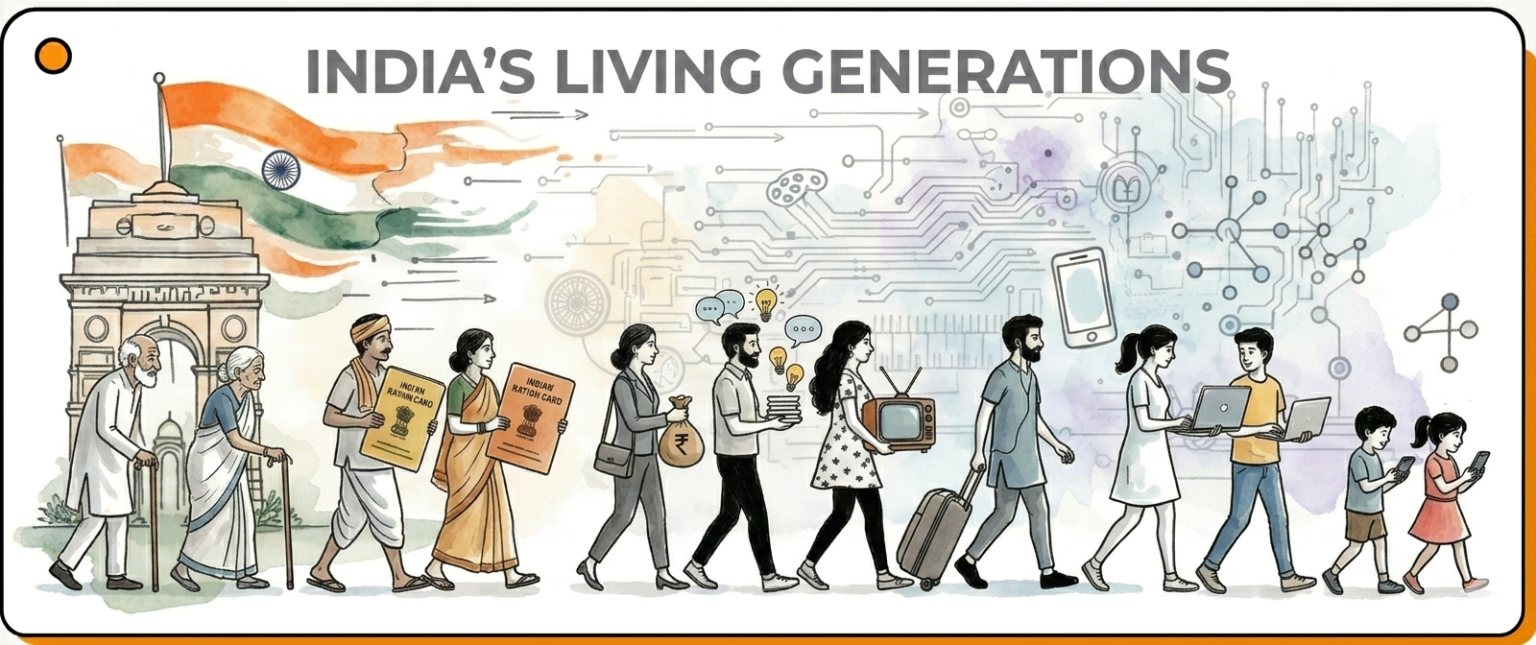
The Lathi Generation (1930-1948), the oldest living Indians.
2. The Generation: Born when the queue was the face of the republic
You learned democracy in your gut before you understood it in your head. Elections meant something shifted – your vote mattered. The Constitution promised you equality. Nehru’s voice came through the radio: temples of modern India. You believed him.
Your nation was building. Dams rose from rivers. The IITs and IIMs were proof that India could dream in steel and mathematics. Radio brought five-year plans into your home – socialism, progress, a future you could almost touch.
But while the nation built, you stood in queues at ration shops, your mother’s rationing book worn thin. States reorganised along language lines. You lived the fracture and reformation of your own nation-borders redrawn, identities reclaimed, everything unstable.
Cinema was your oxygen. Mother India. Mughal-E-Azam. Movies weren’t entertainment – they were proof that beauty existed somewhere. You lived the paradox: a newly independent nation building its future while you stood in queues, waiting. Nehru promised dams and IITs. Your stomach demanded rice and wheat. Both were true. Both were inescapable.
The Ration Generation (1948-1964), the generation that built the nation quietly, on an empty stomach making delayed gratification as a virtue.
3. The Generation born when survival required more wit than the state allowed
You learned to work around the system before you learned to work within it. Indira Gandhi’s hand tightened. Banks were nationalised. Corporate laws strangled ambition. The Emergency arrived-suddenly, dissent was illegal, sterilisation became a state policy. You adapted. You improvised. You survived by your creative workarounds.
Naxalbari burned. Young people died fighting. You found a third way: escape through cinema. Amitabh and Rajnikanth stood on screen-angry, defiant, wearing your rage. Cinema wasn’t entertainment; it was revolution by other means. The ‘Dishoom’ sound when hero beats the villain gives you a cathartic relief.
ISRO launched rockets. Doordarshan broadcast one channel to millions. Planned cities rose from nothing. But the migration was chaotic. Millions left villages for jobs that barely existed. You packed your life into a suitcase.
So you improvised. You built around the cracks. Reliance, Wipro, HCL, Infosys- young people started companies in an economy designed to prevent them. Some of you left the country to UK, Gulf, Bangkok. You learned every rule so you could break it carefully.
You became expert at Jugaad- making something work from nothing, bending systems, finding the gap between law and necessity.
The Jugaad Generation (1964-1978), the generation the system failed, and which fixed itself anyway. Jugaad is typical Indian sytle of resourcefulness, the fix, the creative solution assembled from whatever is at hand. It is a philosophy of survival evolved under institutional failure.
4. The Generation born when the screen brought desire into the drawing room
You grew up watching your nation on television. The Ramayana played on prime time. Your entire neighbourhood gathered. But the same television that showed you divinity also showed you violence. In 1982, the BJP formed. In 1984, Indira was assassinated. Religious identity became content.
You watched your team wining the Cricket world cup. The Asian Games arrived-1984. Color televisions flooded the market. Aspiration entered your home through the screen. Rajiv Gandhi promised you modernity. For seven years, you believed.
The Khans arrived on screen-serious, cosmopolitan, living in a different India. Then, in 1991, Rajiv Gandhi was assassinated. That same year, the economy collapsed. Gold debt. Manmohan Singh opened the markets. Maruti cars. Bangalore transformed. The rules changed overnight. You heard the policy name LPG. You thought it is about Cooking Gas.
Babri Masjid was demolished on live television. The BJP rose to unprecedented power. You received contradictory signals through every channel. Ramayana and MTV. News showing communal violence and advertisements showing the good life.
Cable didn’t just bring channels into your home-it brought the fragmentation of India itself. You became the generation that could receive infinite contradictions and keep watching. You chose to live in nostalgia of your time.
The Cable Generation (1978-1995), the generation that saw a different life on screen and spent the later years chasing it.
5. The Generation born when progress briefly felt inevitable
You first accessed the world through an internet cafe. Dial-up internet. Slow. Shared. The screen glowed in the dark-a window into globalisation that didn’t exist at home. You learned English wasn’t optional anymore. It was oxygen.
Your father’s first cell call came in 1995. The GSM revolution had arrived. Suddenly, you could be reached anywhere. But nobody knew who would lead the country. Coalition politics meant governments collapsed. The shadow of Babri Masjid hung over everything-BJP in power, unstable alliances, the nation reorganising itself around communal lines while you tried to become global.
Your parents had one dream: make your son an engineer or a doctor. Kota became a pilgrimage site. Education wasn’t learning- it transmuted into competition. Call Centers mushroomed everywhere. Everyone who could code or speak English left their towns for cities that hadn’t decided what they were yet. You moved. Your family stayed behind.
Consumer goods arrived like proof of progress. A car was a family milestone. Sony Walkman meant you could carry music. Rehman music feels way ahead of time. Dilwale Dulhaniya Le Jayenge and Aishwarya starrer Jeans showed you foreign locales. You watched Khans command screens.
You existed in the cafe-between tradition and modernity, local and global. Not quite belonging to either. Moving through spaces of transition. Speaking English to strangers online while your parents spoke regional languages. You and your concerns got lost in translation.
The Cafe Generation (1995-2011), the generation that finally arrived and quietly forgot to ask where.
6. The Generation born when the promises ran out of credibility.
You were born into a nation that wanted you to order on Zomato and chant ‘Jai Shri Ram’ at the same time. The algorithm dictates what you saw. Facebook, YouTube, TikTok, Instagram-infinite choice, infinite control. You downloaded an app and the world arrived in 10 minutes. Swiggy. Zomato. Flipkart. Amazon.
Everything became digital. Demonetisation forced you into UPI. Aadhar linked your identity to everything. QR codes everywhere. The government knew where you spent money, where you moved, who you talked to.
In 2011, you watched the Nirbhaya case unfold. Women fought for dignity. Then Article 370 was repealed. The Ayodhya verdict awarded the disputed site to Hindu petitioners. Nationalism became the default setting. Religious discourse played on TV. Baba’s everywhere on screen.You couldn’t opt out of being Indian in a very specific way.
Education became a scam. NEET papers leaked. Byju’s promised miracles. Edtech replaced teachers. Then the pandemic arrived. Work from home sour parents relationships. Virtual meetings. Online classes. Your bedroom became your entire world. Your mental health deteriorated quietly.
IPL fever. Commercialisation of sports. Youtubers became celebrities and role models. The aspirational economy promised anyone could escape precarity through the algorithm. You believed it. You posted. You waited for the algorithm to choose you. It mostly chose advertising.
Market everywhere. Consumption as identity. Gig jobs as work. 10-minute delivery as progress. You could have anything instantly, but nothing permanently. Meanwhile, the air was toxic. The water was disappearing, the votes are devalued. The planet was burning. But there were apps for everything except survival.
The Charvaka Generation (2011-2025), the generation who learned systematic skepticism toward every institution that claims authority over their present life in exchange for a promised future reward. The Charvaka Generation does not reject institutions from ideology. It rejects them from evidence.
Generational Identity, not Inventory
From the Lathi Generation’s resistance to the Charvaka Generation’s, these Generations has moved through successive types of inescapable certainties: Lathi Gen: The baton-external oppression, the colonizer’s violence. Lathi and Ration Gen: Scarcity-the nation rationing everything, teaching you to wait and believe. Juggad Gen: Constraint-rigid state control, teaching you to improvise and find gaps. Cable Gen: Fragmentation-contradictory channels arriving simultaneously, teaching you to hold paradox. Cafe Gen: transitional spaces between home and work, teaching you to translate without belonging. Charvaka Gen: Algorithmic control-infinite choice masquerading as freedom, teaching you to consume without agency.
Generational experience shapes individual consciousness more than anything else. Each generation’s inescapable structures shaped what they could think, what they could imagine, what they had to accept. Understanding these generations means understanding not individual stories, but their unique positioning within modern Indian history. This is neither a chronology nor an inventory. This is the story India’s generations tell: not of progress, but of transformation in the nature of being itself. And had the Chief Justice were aware of it, he might have found a more accurate word than cockroach. Accurate, at least, tends to sting less.
– Dr.S.N Singh